Fossil Ground
Soft bodies, half a billion years. Two Canadian sites preserve bodies rather than shells: an Ediacaran seafloor sealed under ash, and a Cambrian community buried alive in mud. Both depended on the same accident — burial fast enough, and water without oxygen.
Entries in this section
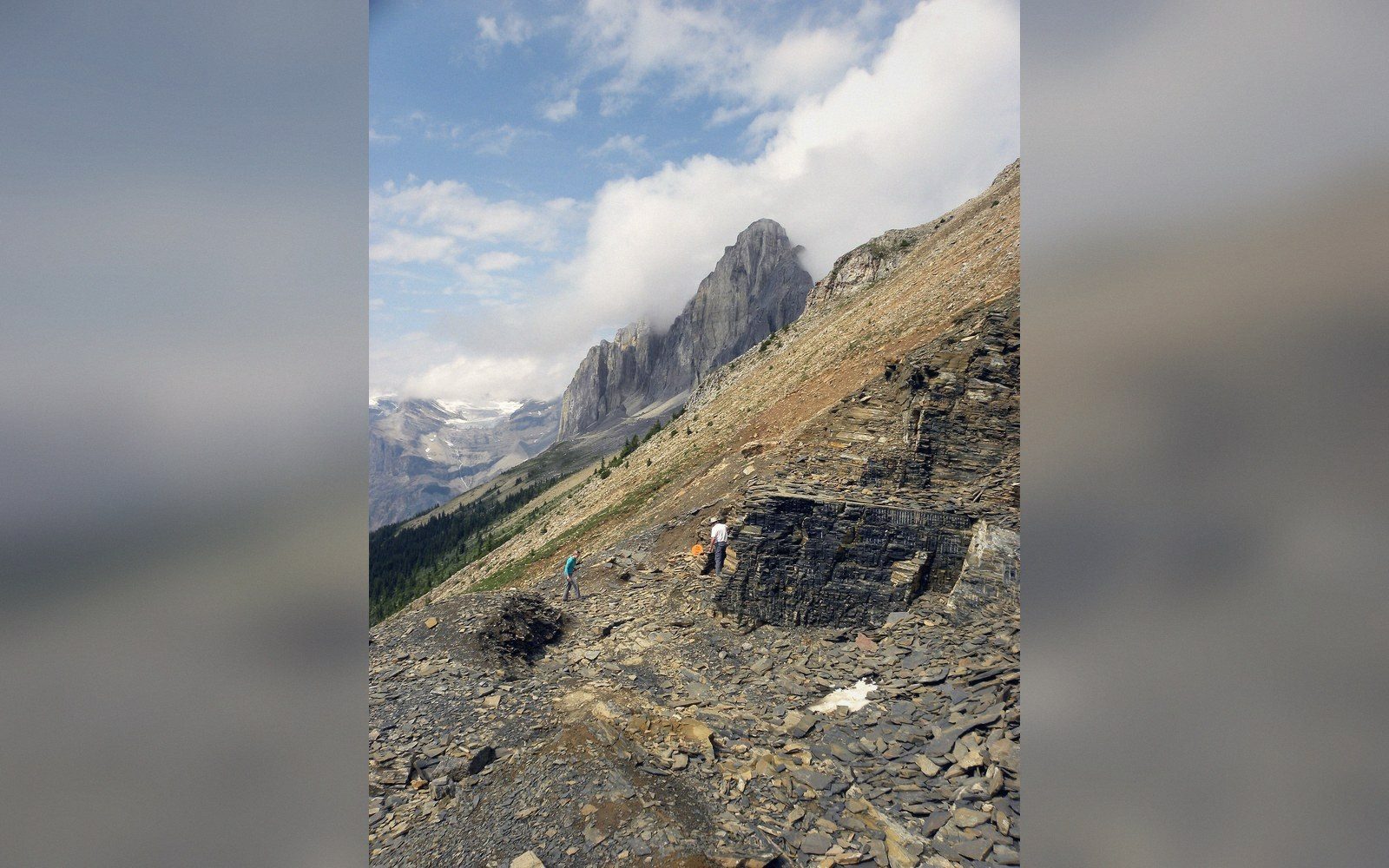
4 entries- The Burgess Shale
Soft-bodied Cambrian animals preserved in mud slides half a billion years ago — the best window that exists onto early animal life.
- Anomalocaris and Opabinia
Animals so unlike anything living that their first reconstructions were assembled wrongly, in pieces.
- Mistaken Point
In Newfoundland, an Ediacaran seafloor community preserved in place under volcanic ash, older than the Burgess Shale.
- Why soft tissue survives
Rapid burial and oxygen-free mud stop decay before the animal falls apart.
Who read this ground
Charles Doolittle Walcott
Smithsonian Institution
Split the first slab of the Phyllopod Bed on a ridge in Yoho National Park in the 1909 field season and returned over subsequent seasons, shipping tens of thousands of specimens east. He read most of the fauna as early members of groups already known.
Named in The Burgess Shale and Anomalocaris and Opabinia.
Harry Whittington
University of Cambridge
With his students, reassembled Anomalocaris from parts that had been catalogued as three separate animals, and presented the corrected reconstruction of Opabinia at the Oxford palaeontology symposium in 1972. The audience reportedly laughed.
Named in Anomalocaris and Opabinia.